Seeley Swan Pathfinder | Karen Williams, Clearwater Resource Council Director of Aquatic Programs
The Clearwater Resource Council (CRC) was awarded a grant from the Western Montana Conservation Commission to financially assist homeowners in getting their septic systems inspected and pumped. Together with the WMCC, CRC will be developing the eligibility requirements for free or subsidized septic system maintenance and communicating the program eligibility in June.
Aquatic invasive species continued to spread in 2025 despite the best efforts of state wildlife officials.
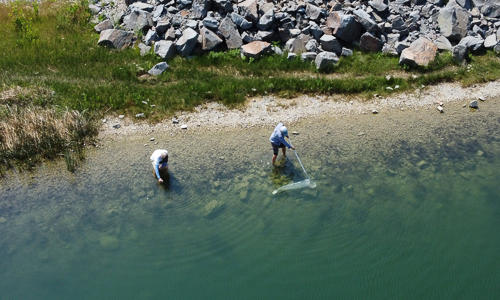
Volunteers and biologists took 3,200 samples from more than 300 Montana waterbodies in 2025. The samples were analyzed for eDNA and other microscopic particles indicative of the bevy of invasive aquatic species that have descended on North America’s waterways in the past decades.
By the end of the year, state officials had catalogued about a dozen new occurrences of aquatic invasive species in the state.
Tom Woolf, the Aquatic Invasive Species Bureau chief for Montana Fish, Wildlife and Parks, said he wasn’t surprised to see samples from Salmon Lake test positive for the invasive faucet snail. Nearby waterbodies in the Swan Valley had already shown signs of the snail, and Woolf surmised that the lake, which sits just north of Clearwater, was already a lost cause.
Fragrant waterlily was detected for the first time in Middle Foy Lake, and two species of snail, one hailing from New Zealand and the other from Malaysia, expanded to lakes in eastern Montana.
All four species had been found in Montana previously.
BUT THE war against aquatic invasive species is far from over, said Woolf, and the best way to fight the incursion is to target the boats that ferry species from one waterbody to the next.
“They’re the alien spaceship that’s going to introduce them to the state, and we have to make sure we get them,” said Woolf at a Jan. 21 meeting of the Western Montana Conservation Commission.
BUTTE, Mont. – The Western Montana Conservation Commission (WMCC) will hold its next two-day meeting on Tuesday, January 20 and Wednesday, January 21, 2026, at the Fairmont Hot Springs Resort.
In 2025, the WMCC awarded over $2.8 million for projects across Western Montana that enhance water quality by mitigating effects from stormwater and septic leachate. With many of these projects launching in 2026, WMCC’s January meeting will dig into what’s next for the Commission and how to best support these efforts in Western Montana communities.
For their first meeting of 2026, the Commission will dive into annual reviews for each committee, reflect on WMCC’s accomplishments so far, and plan for future next steps. The Commission will also provide updates on their aquatic resource protection projects including aquatic invasive species prevention and ongoing water quality outreach events.
Guest speakers, including the Clark Fork Coalition, Montana Fish, Wildlife & Parks, and Montana Department of Environmental Quality, will provide information about water quality and resource protection in Western Montana.
“WMCC meetings bring together partners, friends and allies to build and strengthen relationships in service of aquatic preservation across western Montana. WMCC provides a space to share ideas, learn from one another, and spark new partnerships that turn those shared ideas into action,” explained WMCC’s Grant Administrative Specialist, Krista Lammers.
The meeting is open to the public, and a public comment period will be held each day. To view the agenda, visit the WMCC meeting and events webpage. You will also find links there to register to attend the meeting by Zoom. You will also find links there to register to attend the meeting by Zoom.
About the Western Montana Conservation Commission:
The Western Montana Conservation Commission is administratively attached to the State of Montana Department of Natural Resources and Conservation (DNRC). WMCC is tasked with holding public hearings and monitoring the condition of aquatic and natural resources in western Montana, supporting the continuation of a comprehensive aquatic invasive species prevention program, enhancing collaboration among natural resource partners and agencies and undertaking investigations related to water quality and natural resource utilization. Learn more at www.westernMTwaters.com
HELENA, Mont.—The Western Montana Conservation Commission (WMCC) has awarded approximately $2 million from the U.S. Environmental Protection Agency to support two green stormwater infrastructure projects in western Montana. Green stormwater infrastructure (GSI) is a nature-based solution to manage stormwater pollution by mimicking natural landscapes to allow stormwater to soak into the ground and be filtered. Projects awarded through WMCC’s Stormwater and Septic Leachate Toxics Reduction Grant Program are designed to mitigate stormwater pollution, reduce runoff and provide ample opportunities for community engagement.
“We’re thrilled to support innovative green stormwater infrastructure projects in Montana,” emphasized WMCC Executive Director Casey Lewis. “These showcase projects exemplify design excellence, water quality protection, education and community engagement.”
WMCC is excited to announce the following awardees:
City of Missoula – Missoula Public Library Living Roof Awarded $1,000,000
The Missoula Public Library will transform 13,000 square feet of publicly accessible and visible rooftop in the heart of Missoula into a vibrant living roof, designed to reduce stormwater runoff, filter pollutants, cool the building and lower energy use, all while demonstrating the power of nature-based solutions. This highly visible installation will promote biodiversity and pollinator habitat and engage over 500,000 annual library visitors through interpretive signage, educational workshops, and programming aligned with K–12 science and sustainability curricula. Volunteers will participate in citizen science efforts as well as planting and seasonal maintenance. The Living Roof will serve as a platform for local artists, naturalists, and educators to contribute content and lead programming, amplifying the project’s reach and impact across Western Montana.
City and County of Butte-Silver Bow – Father Sheehan Park Green Stormwater Infrastructure Revitalization Project Awarded $1,090,000
The Butte-Silver Bow Father Sheehan Park (FSP) Green Stormwater Infrastructure Revitalization Project will address inadequate stormwater management at one of Butte’s most historic and well-loved parks. The primary goal is to develop, design and begin implementation of an economically and environmentally sustainable and efficient green stormwater infrastructure complex. This project will build on existing community stormwater partner education and improve the safety and accessibility of Father Sheehan Park and the adjacent urban trail system, while addressing longstanding stormwater management deficiencies. The community will not only protect its recreational assets but also contribute to a healthier, more resilient urban environment for future generations.
WMCC is administratively attached to The Montana Department of Natural Resources and Conservation (DNRC). Funding for this grant comes from a larger grant from the Environmental Protection Agency. WMCC will share updates on the progress of these innovative projects.
The Western Montana Conservation Commission (WMCC) has announced their decision to award approximately $2 million from the U.S. Environmental Protection Agency in support of two green stormwater infrastructure projects in western Montana.
iting the heat produced by the Missoula Public Library’s roof and the need to address polluting stormwater runoff, members of the City Council on Wednesday approved a $149,000 contract to turn the rock roof into a green island.
To aid in the project, the city landed a $1 million grant from the Western Montana Conservation Commission’s green stormwater infrastructure program. The grant requires a 25% match, with the Library Foundation providing $70,0000, and the Missoula Redevelopment Agency (MRA) and Missoula County each contributing roughly $75,000 over the next two fiscal years.
MISSOULA, Mont – The Western Montana Conservation Commission (WMCC) announces its next two-day meeting on September 9 -10, 2025 in Pablo at the Salish Kootenai College.
“As the Western Montana Conservation Commission hosts their September meeting in the heart of the Flathead Indian Reservation, we invite all our friends and neighbors to attend,” encouraged Rich Janssen Jr., the natural resources department head for the Confederated Salish and Kootenai Tribes (CSKT), and WMCC Member. “This is a great opportunity for the local community interested in our waters to learn about WMCC’s and CSKT’s important work.”
The meeting includes a presentation from the CSKT-Montana Compact Implementation Technical Team, and an interactive panel about CSKT’s Aquatic Invasive Species prevention and mitigation efforts. The Commission will provide updates on their aquatic resource protection projects and their Stormwater and Septic Leachate Toxics Reduction Grant Program.
“We’re thrilled to bring forward to the Commission two innovative grant applicants for our Showcase Green Stormwater Infrastructure Projects” shared WMCC Executive Director Casey Lewis. “With funding capped at $1.1 million each, these projects will serve as community hubs for stormwater education while simultaneously playing a critical role in keeping toxic stormwater runoff from reaching our rivers, lakes and streams.”
The meeting is open to the public and a public comment period will be held each day. To view the agenda, see here. To attend the meeting virtually, please register here.
About the Western Montana Conservation Commission:
The Western Montana Conservation Commission is administratively attached to the Montana Department of Natural Resources and Conservation (DNRC). WMCC is tasked with holding public hearings and monitoring the condition of aquatic and natural resources in western Montana, supporting the continuation of a comprehensive aquatic invasive species prevention program, enhancing collaboration among natural resource partners and agencies, and undertaking investigations related to water quality and natural resource utilization. Learn more at westernmtwaters.com.
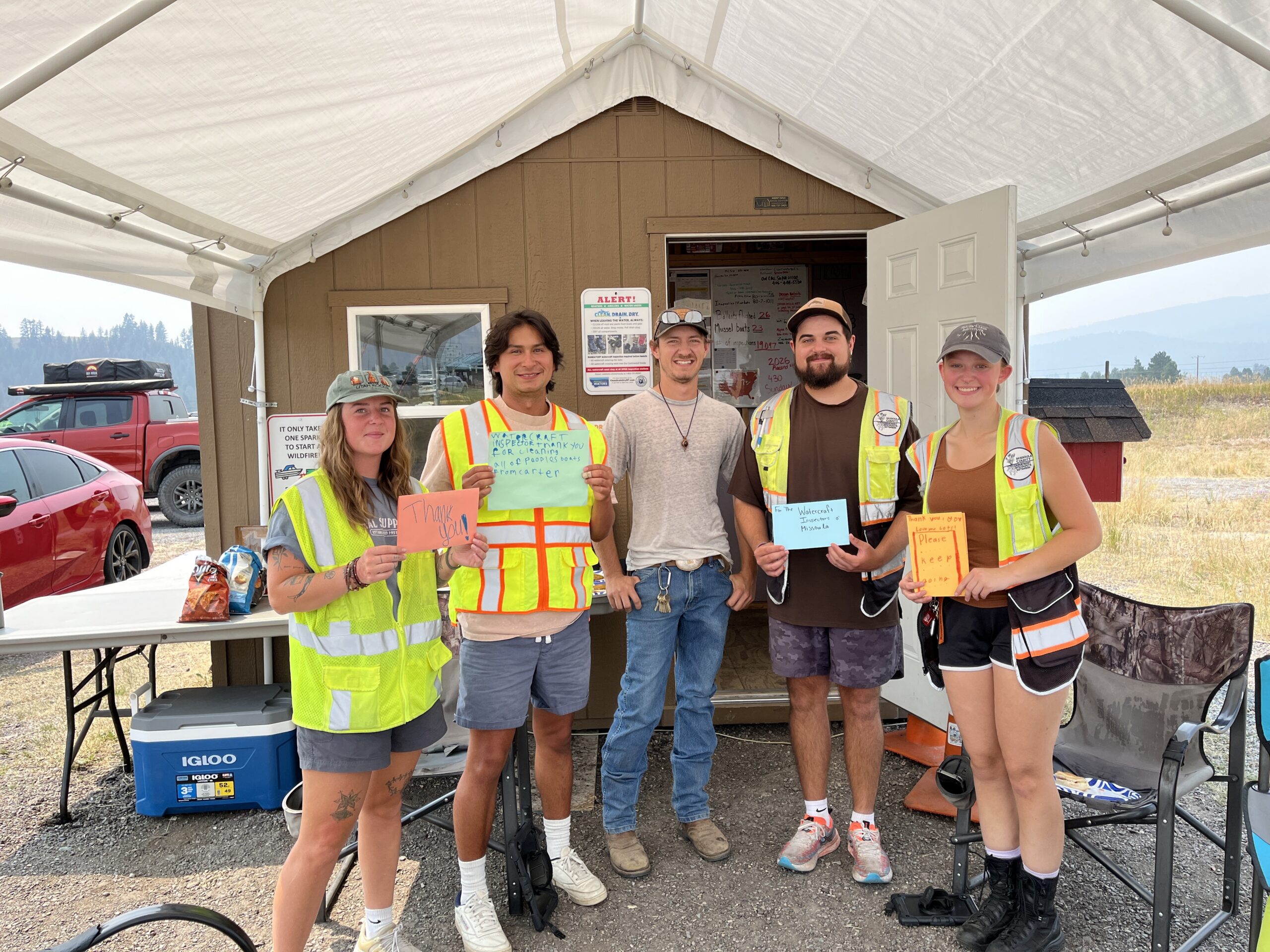
HELENA, Mont. – The Western Montana Conservation Commission (WMCC) today invited Montanans to celebrate the Fifth Annual Watercraft Inspector Appreciation Week from August 4 to 8. Watercraft inspectors protect Montana’s waters by preventing the spread or introduction of aquatic invasive species at inspection stations across the state.
“We recognize the dedication, friendliness and attention to detail the Montana watercraft inspectors deliver every day to protect our water bodies. They are our first line of defense against aquatic invasive species,” said WMCC Executive Director Casey Lewis.
Per Montana law, all watercraft, from pontoons to paddleboards, must stop at every watercraft inspection station they encounter. At the station, inspectors will ask a few questions, inspect the watercraft, and, if necessary, complete a decontamination. Inspectors are trained to ensure all watercraft are cleaned of any plants, mud, or sediment; drained of any standing water; and dried.
Dedicated inspectors have checked over 61,000 vessels in the 2025 season so far. Inspectors have prevented 28 mussel-fouled vessels and over 325 with aquatic weeds from entering Montana’s waters. More than 30 roadside stations across the state are operated by the Montana Department of Fish, Wildlife & Parks and partner organizations such as the Ravalli station, managed by the Confederated Salish and Kootenai Tribes, and the Clearwater Junction station, managed by Missoula County.
“The Clearwater Junction station sees over 25,000 watercrafts in a season and serves as a major line of defense for the Blackfoot, Clearwater and everything downstream,” says Rebecca Busby of Missoula County Aquatic Invasive Species District. “Montana is one of only a handful of states that remains mussel-free, and we’re proud to say that our program and community are helping to keep it that way.”
The WMCC, a commission attached to the DNRC, supports inspectors by bringing supplies to partner-led inspection stations as a thank you while highlighting the important efforts of watercraft inspectors in Montana. Boaters and other water enthusiasts are encouraged to stop by local watercraft inspection stations during Watercraft Inspector Appreciation Week to thank our friendly watercraft inspectors for their dedication and attention to detail in protecting Montana’s waters.
To protect Montana’s waters from aquatic invasive species, the WMCC encourages all Montanans to take advantage of decontamination stations, clean, drain, and dry all watercraft (motorized and non-motorized) and gear, and stop at all inspection stations.
For more information on aquatic invasive species prevention efforts in Montana, visit: fwp.mt.gov/ais.
This summer, researchers are slated to begin a new $4.9 million transboundary study aimed at promoting “a common understanding” of longstanding pollution concerns in the Kootenai River system.
The International Joint Commission, the entity charged with resolving transboundary water disputes between the U.S. and Canada, ordered the study in March 2024 amid rising concerns about the effect that British Columbia mining operations are having on regional water quality. Runoff from the mines flows into the Elk River, a major tributary of the Kootenai River.
WaterNow will partner with the City of Missoula and the Western Montana Conservation Commission (WMCC) to analyze and evaluate stormwater and green stormwater infrastructure (GSI) programs in various states, to inform the development of a funded, sustainable GSI program in Montana. The project team will identify best practices from GSI programs in comparable states; facilitate discussions with the WMCC’s Stormwater Advisory Council, local governments, and other stakeholders to ensure alignment with community priorities; draft policy recommendations and best management practices tailored to Montana’s unique regulatory, environmental, and funding context; and identify federal, state, and private funding sources. This research will inform the creation of an implementation roadmap, outlining the next steps for launching a sustainable GSI program.